Measuring behaviour in Drosophila
Courtship in Drosophila is a fixed sequence. The male orients toward the female, taps her, extends one wing and vibrates it into a song, licks, and attempts to copulate. How long that sequence takes to start and how long it runs are the numbers a behavioural study is built on, and for decades they were obtained by a person watching video and pressing a key. A trained scorer manages a handful of pairs per hour, so the size of a study is set by how much of a person's time it can buy rather than by the biology. I built the computer vision that reads the same events off the video directly.
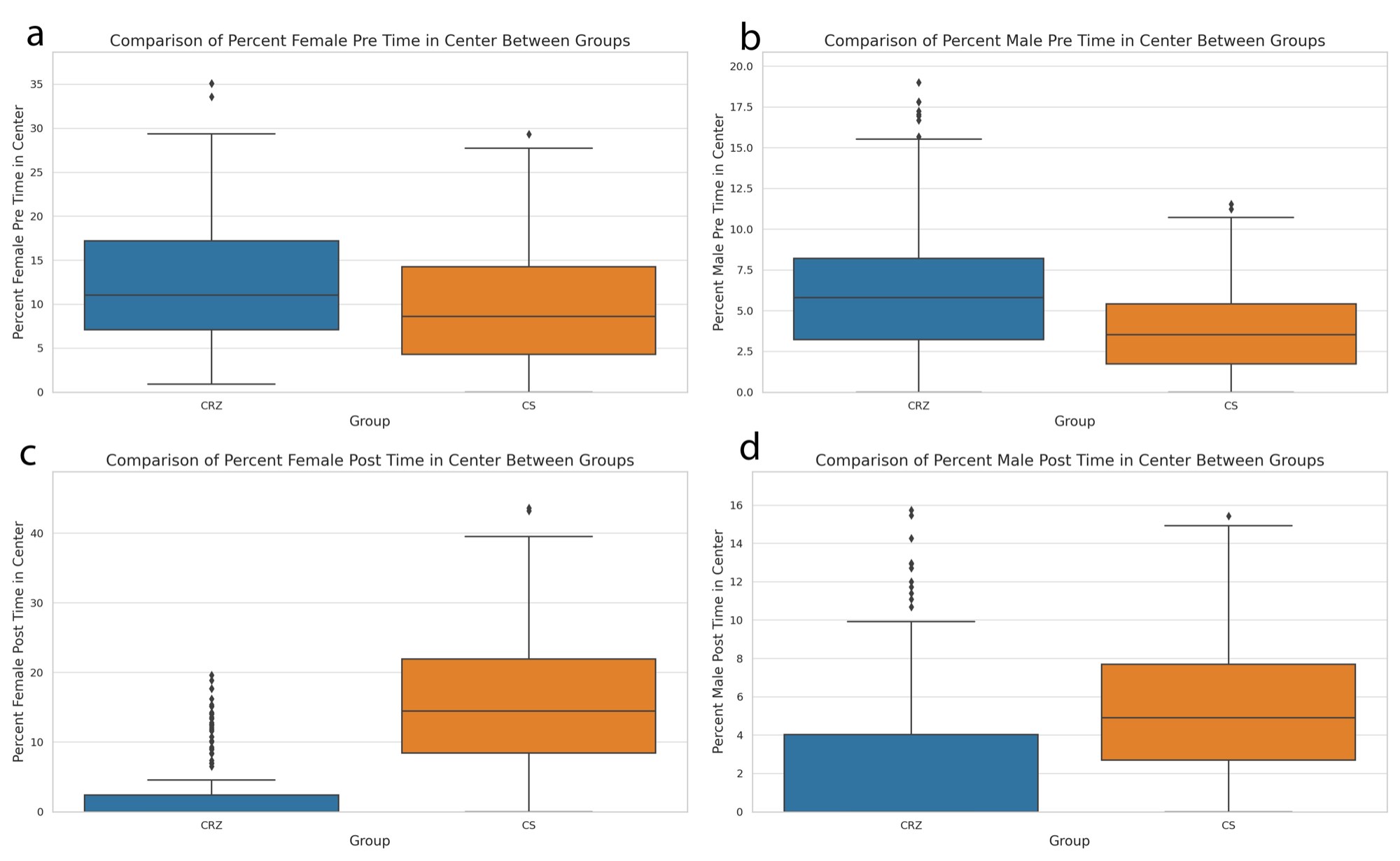
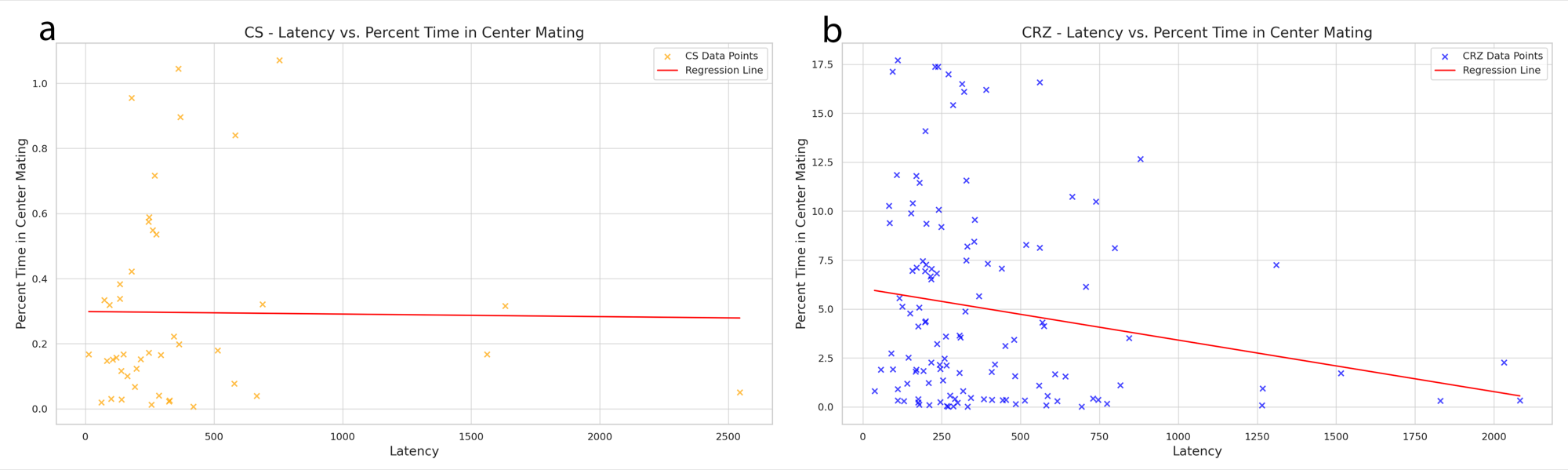
Because the tracker already knew where every fly was in every frame, the same videos could also answer a second question. A fly in an open arena tends to hug the wall and avoid the middle, and how much it avoids the middle is the standard read-out for anxiety-like behaviour, so I asked whether mating changes that and whether Corazonin, a neuropeptide tied to the stress response, is involved. Before mating the Corazonin mutants spent at least as much time in the centre as wild-type flies did, but after mating the two went in opposite directions, with wild-type flies spending more time in the centre while the mutants, the females most of all, almost stopped entering it.
Presentations
- High-Throughput Behavioral Assay Unveils Female Courtship in Drosophila. R. Oliver, S. Yamali, S. Knox, T. Dadyala, L. Shao. International Behavioral and Neural Genetics Society, Western University, London, ON, Canada, 2024.
- High-Throughput Behavioral Assay Unveils Female Courtship in Drosophila. R. Oliver, S. Yamali, S. Knox, T. Dadyala, L. Shao. Sexually Dimorphic Circuits and Behaviors, Janelia Research Campus, HHMI, Ashburn, VA, 2024.
Files
-
[Poster](/work/
centrophobism-poster.pdf ), PDF · 1 page · 2.3 MB The poster version of the study, with the full design, the statistics and the conclusions on one sheet. - [Code](https://
github.com/ )Srujyama/ FlyFlirt
Figures